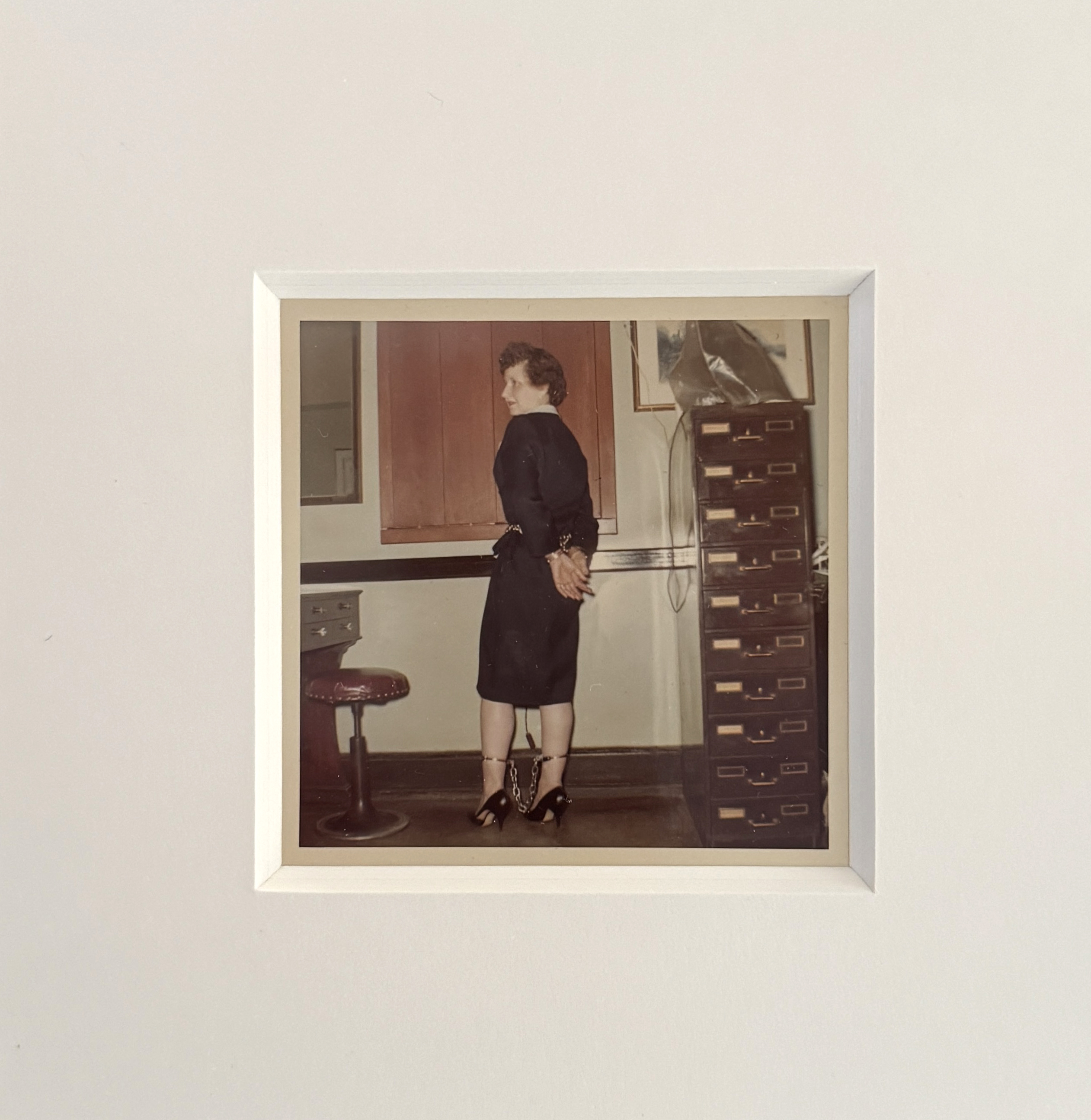
“Chain of Love” invites us into the intimate, enigmatic world of a woman known only as Florence. The installation incorporates original, 1960s prints from Florence’s personal archive, displayed on sculptural plinths made of filing cabinets and painted plywood. Together, the works explore the complex interplay of power, performativity, and the politics of desire.
Discovered at a flea-market auction, the collection of images depicts Florence in her own carefully staged vignettes. At first, she appears as a perfectly manicured emblem of domesticity - hair coiffed, clad in low-heeled shoes and practical skirts, smiling directly into the camera. Closer scrutiny reveals various vintage restraints - handcuffs, shackles, and chains - that bind her arms and ankles. This peculiar, unexpected detail stands in stark contrast to the surrounding visual information, while Florence’s radiant smile and direct gaze contradict the suggestion of external constraint. Confident and poised, her enigmatic composure prompts deeper contemplation of identity, fantasy, control, and aspiration.
The intimate images are presented on industrial filing cabinets that function as totems of our private, inner worlds. Equipped with locks, these cupboards are ideal hiding places for secrets and vices, where old tax returns and birth certificates are stashed away next to drug paraphernalia and porno magazines. The filing cabinets are installed tightly within the gallery space, positioned to minimize movement and, in turn, emphasize the embodied awkwardness of voyeurism. As viewers navigate the narrow gaps, they are confronted with both the paradox of possession and the emotional weight of nostalgia - of being both chained to and liberated by our desires.
Through these gestures, “Chain of Love” asks what it means to collect and to be collected. In a cultural landscape where online archives are dominant, Graves resurrects physical artifacts from Florence’s personal history, allowing her story to linger - simultaneously private and public, collective and singular. Each photograph is suggestive of a larger story that is ultimately withheld. The withholding of information becomes another form of constraint, teasing the viewer with narratives that can only be speculative. As privacy becomes increasingly scarce, Florence’s anonymity sparks questions about the complexities of identity, desire, and memory in the digital age.
Paul Graves (b 1969 USA) is a multidisciplinary artist whose work spans photography, film, design, fashion and creative direction. His practice explores the intersection of archival obsession, personal memory, and cultural storytelling. Graves began his career studying under Michelangelo Pistoletto at the Academy of Fine Arts in Vienna. His signature style is not confined by medium, but a way of seeing - whether creating a photograph, directing a film, designing a book cover, shaping a luxury campaign, or conceiving an architectural space. Known for blending high and low culture, Graves generated striking imagery for brands like Nike, Hermès, and Absolut Vodka, and contributed to Vogue, The New York Times Magazine, Elle, and GQ.